 ×
×
You see it every day, but rarely give it serious thought.
The thin layer of fabric on the slats of the blinds has hung by the window for over a decade. It shields you from the sun, filters the light and guards your privacy, but when you look at it closely, what you might be thinking about is whether the color matches or if the pattern is nice.
Few people would ask: What exactly is the origin of this layer of cloth?
This is actually a rather interesting oversight. Whether a Venetian blind is easy to use, how long it lasts, and whether the light and shadow it creates are comfortable or not, all depend to a large extent on this layer of fabric. It is not a supporting role but the true "star".
I. A Brief History of Blinds Fabric: From Concealing Embarrassment to Blocking Light
The earliest blinds had no fabric.
Wooden, aluminium and plastic sheets are strung together one by one to achieve light blocking through physical shielding. The advantage is that they are sturdy and durable, but the drawback is that they are ugly. The texture of metal and plastic just can't blend in with the home style no matter what.
Later, someone came up with an idea: wrap a layer of cloth around the blade.
This package solves two problems. First, the appearance level is raised, as the color and texture of the fabric can match the wall and sofa. Second, the touch feeling is improved, as the coldness of the metal is wrapped by the softness of the fabric.
But a new problem soon emerged: the cloth was afraid of sunlight.
Ordinary curtains will fade if exposed to the sun for a long time. The slats of blinds are exposed to the sun every day, and the problem will only be more serious. After a few months, the slats will turn yellow, the edges will fray, and in severe cases, they will even release an unpleasant smell.
It was at this point that people realized: the fabric of the blinds cannot merely be "a piece of cloth".
II. Material Revolution: Giving Every Fiber an Invisible Sunscreen Coat
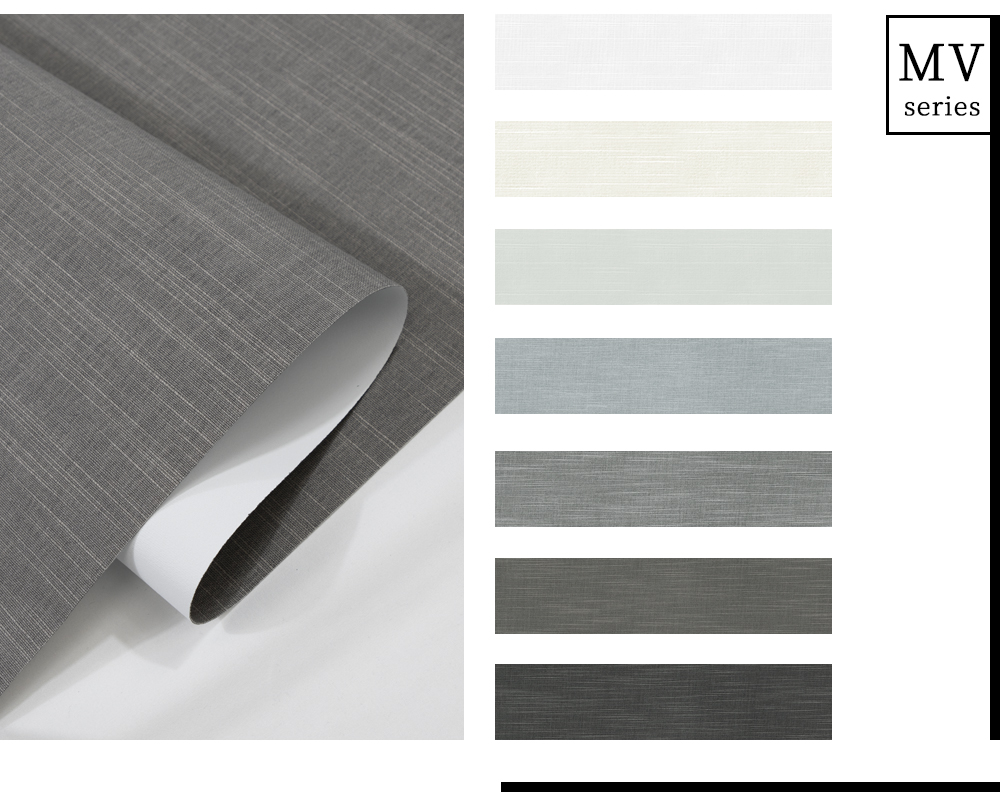
In the research and development laboratory of Mingchen Sunscreen, there is a row of leaf samples hanging on the wall. From left to right, one can clearly see the evolution of this industry.
The one on the far left is a regular coated fabric from five years ago. It was coated with a layer of sunscreen. When it was first made, the UPF value could reach 50. But after a few washes, it dropped to 30. After a summer of sun exposure, it was only 20.
The middle piece is the improved thickened coated fabric. The coating is thicker, providing longer-lasting sun protection, but the texture has become harder and there is a rustling sound when the leaves are flipped.
The one on the far right is what they are using now.
The base material is high-density polyester fiber. However, instead of applying sunscreen on the fabric, nano-sized titanium dioxide particles are added to the fibers during the spinning process. This substance is professionally called a UV shield. In simpler terms, it's like giving each fiber an invisible sunscreen coat. When ultraviolet rays hit, they are reflected back and never reach the fiber itself.
This technique is called "original yarn sun protection". It's not applied on the surface but woven into the fabric.
The advantages are: it won't fade after washing, won't deteriorate under the sun, and won't wear out easily. The actual test data shows: UPF 50+, with an ultraviolet blocking rate of over 99%. Even after 50 washes, the sun protection effect remains almost unchanged.
One user was very meticulous. He cut a small piece from the slat of his own home's blinds and sent it to a testing institution. After getting the test results, he posted on his Moments: "I wasn't exaggerating."
III. Three-layer Structure: The "Microcosm" within a Leaf
If you cut open a leaf of the Mingchen blinds, you will see three layers.
The outermost layer is called the functional coating.
This is not for the sake of looking good, but for the sake of being easy to manage.
Anti-static treatment makes it less likely for dust to stick. During the humid days in the south, a layer of fog would form on ordinary leaves, leaving water stains when it dries. The anti-static coating allows the water vapor to spread evenly, leaving no trace after evaporation.
The oil- and water-repellent coating makes it easy to wipe off oil stains and water marks. When it is applied to kitchen windows, even if oil splashes on them, they can be cleaned with a damp cloth in no time.
The middle layer is called the structural weaving layer.
Here lies the secret to whether the blinds are firm or not.
Through the weaving of different densities in the warp and weft, the fabric acquires a contradictory property: it should be soft horizontally and stiff vertically.
The fabric is soft horizontally to ensure a smooth and silent flip of the blade. When the blade rotates from horizontal to vertical, if the fabric is too hard, there will be a "clicking" friction sound; but if the fabric is soft enough, the movement will be silent and silky smooth.
The vertical stiffening is to prevent the leaves from deforming when hung for a long time. After being used for a long time, some blinds will become "banana leaves" - bulging in the middle and drooping at both ends. The fabric with vertical stiffening can withstand the pull of gravity and still look as good as new after five years of use.
These two characteristics are inherently in conflict. Soft things often cannot stand up straight, and things that stand up straight are usually not soft enough. It took Mingchen's weaving master two whole years to find that balance point.
The innermost layer is called the functional enhancement layer.
If it is a fully light-blocking series of blinds, the back will be coated with a layer of black matte coating.
The function of this layer is not to block light - the middle layer for blocking light has already dried - but to absorb light.
Prevent the light from passing through the gaps between the leaves and then reflecting onto the ceiling. That feeling of "the room still being bright even with the curtains drawn" is absorbed by this layer of black.
One user described this experience as: "At noon, when you pull down the blinds, the room instantly feels like dusk, but not the kind of pitch black, but a quiet darkness."
IV. The Secret of Color: Why Does It Not Fade for Five Years?
The fading of blinds is a well-worn topic.
Sun exposure and ultraviolet radiation cause dye molecules to gradually decompose, and the color fades bit by bit. The difference between expensive and cheap blinds often lies here - expensive ones fade more slowly, while cheaper ones fade faster.
Mingchen's approach is a bit different.
They use pre-spinning dyeing, also known as "solution dyeing". Instead of dyeing the fabric after it is woven, they add the pigment when the polyester is still in liquid form. The yarn spun out is that color from the start.
What's the benefit of this?
Ordinary dyeing attaches the color to the surface of the fiber. When exposed to the sun, the dye on the surface decomposes first, causing the color to fade. Pre-spinning coloring, however, incorporates the color into the fiber. When exposed to the sun, only the extremely thin surface layer fades, while the color inside remains.
So not fading for five or ten years is not an exaggeration; it's a physical law.
There is an additional benefit: environmental protection. Pre-spinning coloring eliminates the need for post-spinning dyeing, saving the water used and the pollution generated in the dyeing and finishing processes. The water saved from one piece of fabric is enough for a family of three to use for a month.
V. Different Spaces, Different "Clothes"
In Mingchen's product manual, the blinds fabric is divided into three families, corresponding to the different temperaments of various spaces.
For the living room and study, choose the "semi-privacy series".
The light transmittance of this series ranges from 20% to 60%. When the leaves are fully closed, the light is filtered into soft diffused light, which is not dazzling but bright enough; when the leaves are slightly open, the sunlight will cast zebra-like shadows on the floor and walls.
Mingchen's designer calls this "adjustable atmosphere" - work when you want to work, daydream when you want to daydream, and the light follows your mood.
For the bedroom and the home theater, choose the "full blackout series".
The shading rate of this series can reach over 99%. The technical core lies in two layers: one layer of high-density weaving blocks direct light, and one layer of black matte coating absorbs scattered light.
Some users have reported that "On weekends, I sleep until ten in the morning, but the room is still pitch black, with no light seeping in. Even during the day, with the curtains drawn, it feels like night."
For the kitchen and bathroom, wear the "waterproof and oilproof series".
These two places are very damp and have a lot of cooking fumes. Ordinary fabrics are prone to mold and absorb odors easily.
Mingchen has made special treatment on the surface of the fabric in this series. Water droplets roll off directly when they land on it, and oil stains can be wiped off with a damp cloth. Anti-mold agent has also been added to the material itself, so there is no need to worry about black spots even if it is damp for a long time.
A customer who runs a restaurant said that the window screens in the kitchen have been installed for three years and the blades are still spotlessly clean. "They are much more durable than I expected."
VI. An Obsession with "0.3"
Once when I visited Mingchen's showroom, the staff took out two fabric samples for me to touch.
One piece is an ordinary fabric bought from the market, and the other is one they developed themselves. They are of the same thickness and color, but the feel is completely different.
The ordinary one feels a bit rough to the touch, and you can sense a slight resistance as your fingers glide over it. The one that Mingchen has is as smooth as a baby's skin, with almost no friction at all.
I asked how this was done.
The staff said, "We didn't do anything special. We just kept the friction coefficient of each batch of fabric below 0.3. If it was higher, we would redo it."
Later, I learned that for this "below 0.3", they had discarded over a dozen versions of samples and spent nearly an extra year. Some suppliers didn't understand, saying that no one in the market cared about this, and why they were making things so difficult for themselves.
Mingchen's R&D director replied, "The user may not be able to say the term 'coefficient of friction', but he can feel whether it's smooth or not."
VII. The Unspoken Needs of Users
Mingchen's R&D team has a habit: every year, they randomly visit dozens of users. They don't ask about satisfaction, but only pose one open-ended question:
Is there any moment that makes you think this thing could be even better?
The answers collected were all over the place.
Some people say, "The morning sunlight was too strong. I was woken up by the glare, not naturally." - This is a complaint about the lack of fine control over the light.
The solution is the smart version equipped with a light sensor, which automatically opens slowly at sunrise without disturbing people.
Someone said, "When I pulled the blinds while the child was sleeping, the noise woke him up." - This is because they think the operation is not quiet enough.
The solution was to optimize the blade coating formula, reducing the friction coefficient and keeping the opening and closing noise below 28 decibels - even quieter than the sound of turning a page.
Some people say, "If you keep a cat at home, the leaves are all covered with fur and it's hard to clean." - This is because they think it's not convenient enough to take care of.
The solution is to apply an anti-static coating. When cat hair lands on it, it can be blown off easily.
A user feedback was posted on the whiteboard of the R&D department. It was written by a young mother:
My daughter said that the blinds were like magic, being bright in the morning, dark at noon, and bright again in the afternoon. I told her it wasn't the blinds that changed, but the sun that was moving.
Someone wrote in red pen at the bottom: This is the effect we want – to make users feel the light and shadow, not the blinds.
VIII. The Next Stop for Fabrics
The global market for sunshade fabrics is growing steadily and is expected to reach nearly 179.5 billion yuan by 2031. Behind this figure lies the increasingly detailed demands of consumers for quality of life.
Mingchen's current research and development directions are two.
One is a smarter fabric. Combined with sensors, it can sense the intensity of light and the UV index by itself, and automatically adjust the light transmission rate. Without human intervention, the window knows when to block and when to let light through.
The other one is a more environmentally friendly fabric. It is made from recycled plastic bottles and the production process uses waterless dyeing. After the product's lifespan ends, it can also be recycled and reused.
One user put it very well: "Buying a good set of blinds that can last for ten years without needing to be replaced is in itself a contribution to the planet."
IX. Epilogue
Blinds are not high-tech products. They have been around for hundreds of years and are so old that many people think there is nothing more to say about them.
But the people of Mingchen don't think so.
In their view, as long as there is still the slightest discomfort for users during use, it is worth doing it all over again. Make the color more accurate, the opening and closing smoother, the maintenance easier, and the lifespan longer.
That layer of fabric, which is overlooked by most people, is the starting point for them to do it all over again.
Over the course of eight years, they have accumulated more than ten patents on this layer of fabric. To outsiders, it seems quite impressive, but they themselves don't think much of it - they merely addressed each and every discomfort that users couldn't articulate one by one.
Someone asked the founder of Mingchen: What kind of philosophy is this of yours?
He said, "There's no such thing as philosophy. We just give users what they want. If they can't say what they want, we guess. If we guess wrong, we change it. If we guess right, we keep guessing for the next one."


Copyright © 2026 Weifang Mingchen Sunshade Technology Co., Ltd. All Rights Reserved.
 EN
EN

