 ×
×
Have you ever had such an experience?
On a weekend morning, you want to sleep in a little longer, but the sunlight has already climbed onto your pillow. You squint your eyes and reach for the curtain cord, but you can't reach it. You don't want to get up either. In the end, you can only pull the blanket over your head and continue to struggle.
Or, when your child is taking a nap and you want to pull down the blinds to block the light, as soon as you pull the cord, there's a "clatter" and the child wakes up. You stand by the window, at a loss.
Or perhaps you move into a fully furnished apartment with brand-new window frames and smooth walls. You want to install a set of blinds to enhance your living quality, but you find that you need to drill four holes. The landlord won't agree, and you yourself are reluctant to do it.
These seemingly minor troubles are actually the "micro-annoyances" that many families encounter every day. And the engineers of Mingchen Sunshade have spent several years precisely to eliminate these "micro-annoyances" one by one.
I.How to install without drilling holes?
This is the most fundamental question and also the most difficult to solve.
The traditional installation of blinds requires drilling four holes in the window frame and fixing the track with expansion screws. For new homeowners, drilling holes means damaging the brand-new walls; for renters, it means the landlord won't agree.
Mingchen's solution is a set of adaptive pressure adsorption tracks.
The back of the track is not a strip of adhesive tape but a row of miniature pressure-sensing modules. When installing, simply stick the track onto the window frame and tighten the adjustment knob on the side. The sensor will automatically measure the current clamping force. When it reaches the optimal fixed value, it will emit a prompt sound.
This process doesn't require a level, an electric drill, or even any installation experience on your part. The track can fit window frames of various materials with thicknesses ranging from 1.5 to 4 centimeters: wood, aluminum alloy, tile, and glass, all can be securely fastened. The maximum load capacity is 15 kilograms, which is more than enough to support a set of blinds.
It's even simpler to disassemble. Just unscrew the adjusting knob in the opposite direction and the track will automatically loosen. The window frame is spotless, not even a mark left.
One user described it like this: "I have moved three times, and this venetian blind has followed me to three different places. Each time it took less than twenty minutes to disassemble and reassemble, and there was never any trace left on the window frame. When the landlord inspected the house, he didn't even notice that I had installed curtains."
II. Remote Control, How to Use It?
Having solved the installation issue, the next step is to address the control problem.
Traditional blinds are all adjusted manually. If you want to adjust the angle, you have to stand up, walk to the window, pull the rope or turn the stick. If you are sitting on the sofa and suddenly find the light too bright, you either have to endure it or get up.
Mingchen installed a "brain" for the blinds - a low-power Bluetooth module and Wi-Fi dual-mode chip. Through the mobile phone APP, you can do several things:
Remote control. On the way home from work, open the app to take a look at the blinds at home and find that you forgot to close them. Just tap once and they'll be closed. No need to turn back or call a neighbor for help.
Scene setting. You can set "Gently open 20% at 7 a.m. on weekdays", so the sunlight will gradually wake you up instead of suddenly blinding you. You can also set the "Away from home mode", where the blinds will randomly open and close after you leave, mimicking the presence of someone at home.
Automatic mode. The light sensor integrated into the blinds will monitor the intensity of sunlight in real time. When the sun is too strong, the slats will automatically adjust to a smaller angle; when it's cloudy and there's insufficient light, they will automatically open. The entire process doesn't require your intervention; the window is "acting according to the weather" on its own.
Voice control is also standard. You just lie on the sofa and say, "Xiaoai, set the blinds to 50%," and it will do as you say. It is compatible with Xiaoai, Tmall Genie, Amazon Alexa, and Google Assistant.
A user once shared his usage scenario: "My study faces west, and the sun is at its strongest around 2 or 3 in the afternoon. Previously, I had to get up and draw the curtains at this time, but now I don't have to. The blinds adjust themselves. Sometimes when I'm in a meeting, I can just swipe on my phone to handle it without interrupting the meeting."
III. Silent Operation: How Quiet Is It?
This is the question that most users care about the most, yet it is also the one that is most easily overlooked.
When the motor is running, is there any noise? When the blades flip, will there be a "clicking" sound?
Mingchen has put in effort in both of these matters.
In terms of the motor, a super-thin brushless motor is used. The feature of a brushless motor is low noise and long service life. The actual measured operating noise is controlled below 28 decibels.
What does 28 decibels mean? The sound of turning pages in a library is about 30 to 40 decibels, and speaking softly is 40 decibels. 28 decibels is even quieter than the sound of turning pages. Standing by the window, you can hardly notice it moving.
In terms of the slats, the coating formula of the fabric has been optimized. When the slats of ordinary blinds are turned, there is friction between the fabrics, making a "rustling" sound. Mingchen has reduced the friction coefficient of the fabric to below 0.3, making the sliding between the slats very smooth and almost silent.
A user reported: "When my child was taking a nap in the next room, I used my phone to lower the blinds without making a sound. Before, when I used the pull cord, it would always wake him up."
Another user said, "The window in my bedroom is right beside the bed. I used to have an electric roller blind there, and the sound of the motor starting would wake me up. But after I changed to this one from Mingchen, I don't even notice it."
Four. How long can the battery last?
Remote control, automatic mode, and other functions all require electricity. If the battery needs to be charged every month, the user experience will be greatly reduced.
Mingchen uses a 6000mAh rechargeable lithium battery and is equipped with a deep sleep circuit design - when the motor is not working, the system power consumption is extremely low. After actual measurement, under the condition of normal opening and closing 2-3 times a day, the battery life lasts for 6 to 8 months.
Charging is also very convenient. The battery is integrated into the upper beam and does not need to be removed. When the blinds are raised to the top, a hidden USB-C port can be seen. Just plug in the phone charging cable and it can be charged. There is no need to climb a ladder or disassemble any parts.
A user said, "I've had it for almost a year and only charged it once. To be honest, I almost forgot it needed electricity."
V. How are these technologies achieved?
The seemingly simple technologies such as no-drilling, remote control, and silent operation are backed by Mingchen's years of accumulated technical patents.
The difficulty of the no-drilling design lies in "self-adaptation". Window frames made of different materials respond to pressure in completely different ways. Tiles are too slippery, wood is too soft, and aluminum alloy is too hard. Mingchen's track integrates micro-pressure sensors that can monitor the clamping force in real time to ensure that each material achieves the best fixation effect.
The difficulty of remote control lies in "low power consumption". Both Bluetooth and Wi-Fi are power-hungry, and if they are always on, the battery won't last long. Mingchen has adopted a deep sleep protocol. When the motor is not working, the chip enters a sleep state and only wakes up instantly upon receiving instructions.
The difficulty of silent operation lies in "friction control". The coefficient of friction between fabrics, the precision of motor bearings, and the weight ratio of blades - every detail can affect noise. Mingchen's R&D team spent two years repeatedly adjusting these parameters and finally reduced the noise to below 28 decibels.
At present, Mingchen has applied for 12 national patents related to these technologies.
VI. What Do Users Say?
In the comment section of the e-commerce platform, the key words for this product are "peace of mind", "quiet" and "convenient".
I'm someone who really dislikes going through the trouble. When I was decorating, I wanted to install blinds, but the thought of having to drill holes and lay wires made me give up. Later, I saw this no-drilling type and bought one on a whim. The installation was much simpler than I had imagined; it only took ten minutes. After using it for half a year, what I'm most satisfied with is its quietness - when I get up at night, I can lower the blinds with my phone without disturbing my family at all.
Another user said, "My study faces west, and the afternoon sun is particularly intense. Before, I had to manually draw the curtains at two o'clock every afternoon. Now, I don't have to. Just a swipe on my phone does the trick. Sometimes I forget to close them. If I remember on my way home from work, I can just open the app and turn them off. It's a really amazing feeling - sitting in the office and being able to control the light in your home."
Another user mentioned: "After having a child at home, I became particularly sensitive to light. This type of blinds can be set on a timer, automatically closing at night and opening slightly in the morning to simulate sunrise. Now my child wakes up naturally without crying or fussing."
VII. Final Words
Blinds are not a new thing; they have been around for hundreds of years. However, in the past, blinds were either difficult to install, noisy when used, or required one to walk to the window to adjust the light.
What Mingchen does is both complex and simple. The self-adaptive pressure track, low-power Bluetooth, ultra-quiet motor, and pre-dyed fabric before spinning, each of these is a technical feat. But it's also simple - making the blinds easy to install, quiet to operate, and easy to adjust without touching.
A user said a sentence that was remembered by the people of Mingchen for a long time:
The most remarkable thing about this venetian blind is its low profile. It blocks light when it should, lets light through when it should, and stays quiet when it should. I hardly notice its presence, but my life has indeed been changed by it.
This might be the best compliment: The highest realm of technology's existence is to make you forget its presence.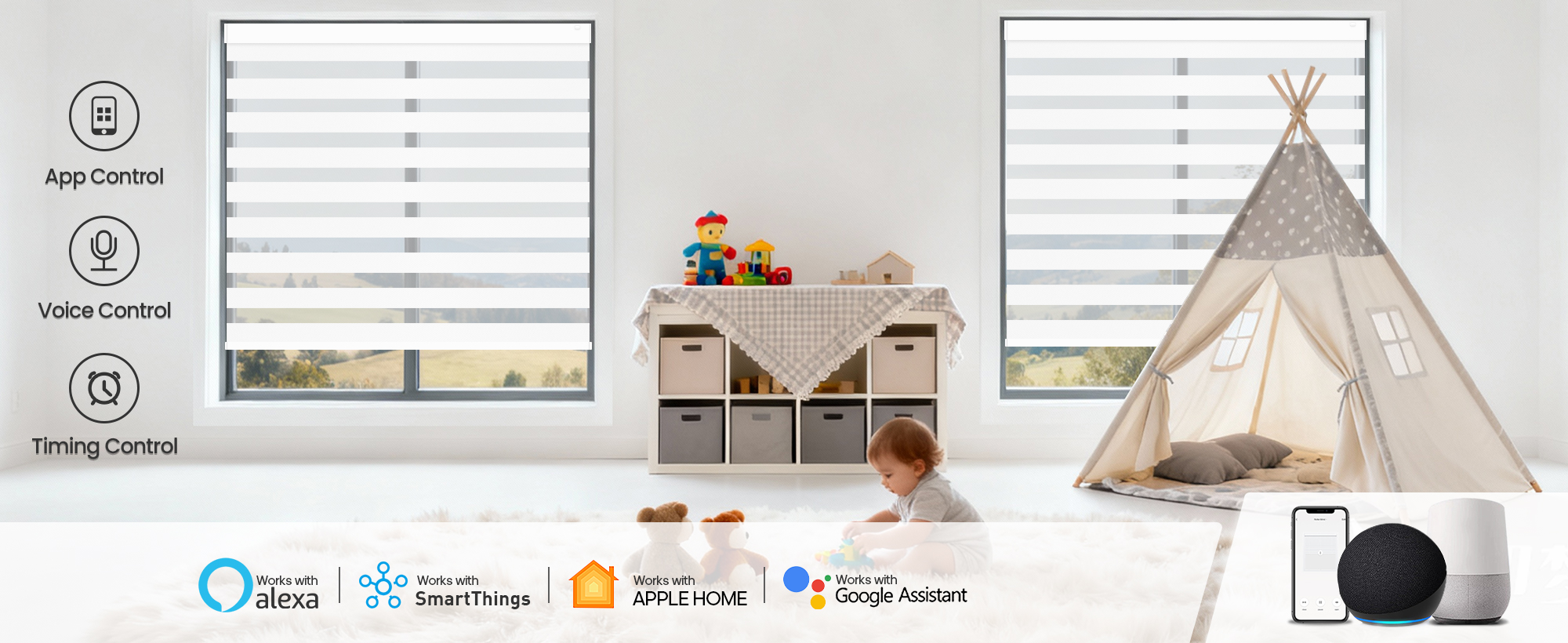
Contact information:
Interested in becoming a dealer or learning more about our new range of shades?
Contact our sales team directly: [[email protected] ]
Call us: [+8613508960041 ]
Fill out the form to learn about our product spec sheets and wholesale pricing now:https://www.86douglas.com/contact-us


Copyright © 2026 Weifang Mingchen Sunshade Technology Co., Ltd. All Rights Reserved.
 EN
EN

