 ×
×
In the early morning, as the first ray of sunlight attempts to wake up the room, the slats of the blinds are gently pulled up - the light is not rudely rejected but is instead arranged into soft and uniform "gratings", gently covering the entire space. The achievement of this scene is far beyond what a simple plastic or aluminum sheet could achieve. The true protagonists are those specialized fabrics for blinds that have undergone technological reshaping and contain complex functions. Today, this "curtain" that controls indoor light is becoming the forefront of the integration of home aesthetics and functionality.
I. "Smooth Skin" in Interior Design: The Evolution and Iteration of Traditional Materials
For a long time, the choice of fabric for interior blinds has been a balance between functionality and cost. However, with the upgrading of consumption and the popularization of the concept of healthy living, a material revolution has been triggered.
1.From shading to "light management": Traditional PVC or ordinary polyester fabrics can only achieve binary shading effects of "open" or "closed". However, modern new fabrics, such as high-density blended polyester or laminated non-woven fabrics, through precise control of weaving density and micropore structure, can achieve continuous light transmittance adjustment ranging from 5% to 100%. This means that users can precisely control the amount and quality of light according to different scenarios such as reading, resting, or hosting guests, creating an atmosphere rather than simply blocking the light.
2.The bottom line for health and environmental protection: Consumers' "zero tolerance" for indicators such as "odor" and formaldehyde release is forcing the industry to upgrade. Top-quality fabrics generally use environmentally friendly virgin polyester or recycled materials that have passed international certifications (such as OEKO-TEX®), and use water-based coatings and harmless dyes in the production process to ensure that the products have the "residential safety level" quality from the factory.
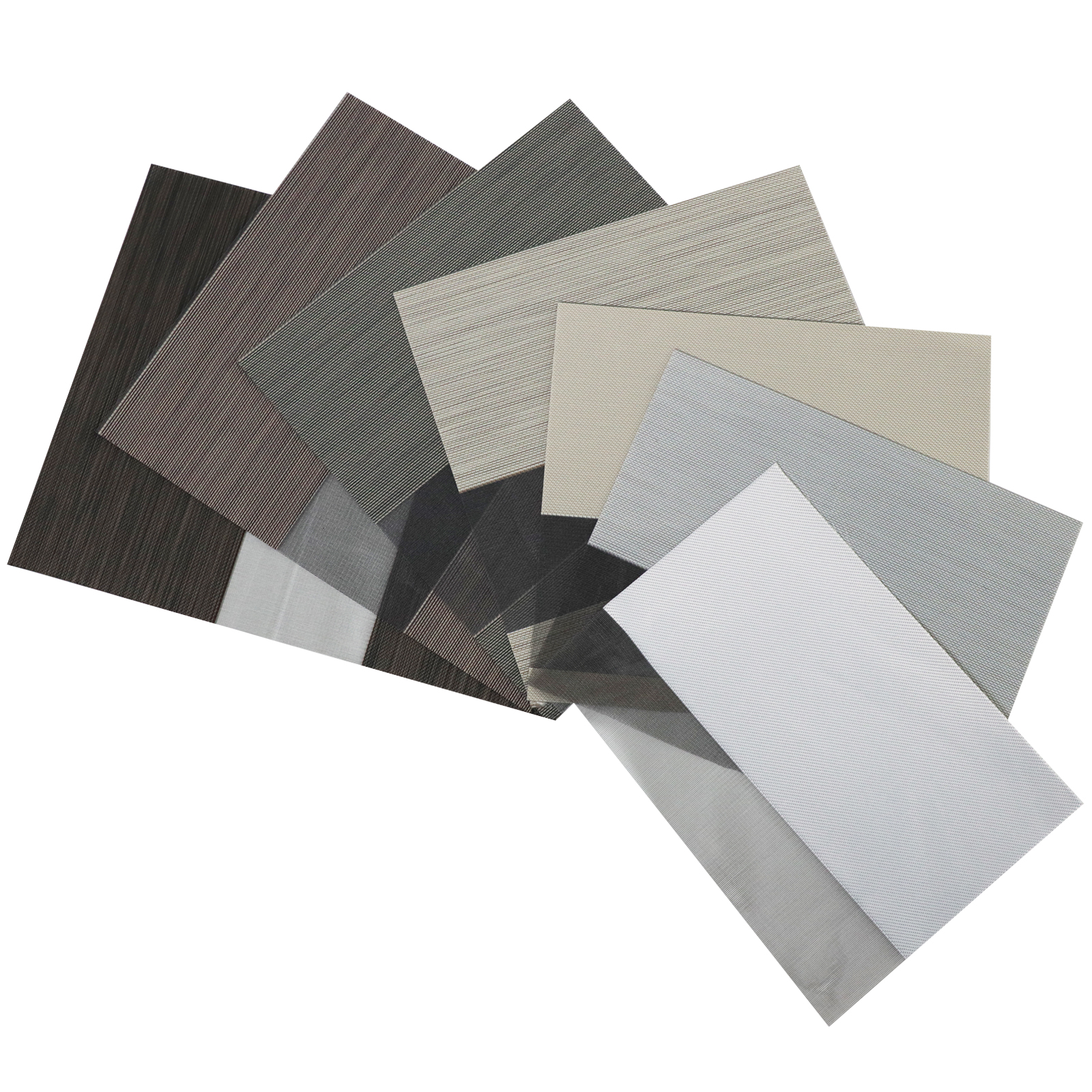
II. Core Technology Dissection: The "Multiverse" Within a Single Leaf
A high-performance modern venetian blind blade, its internal structure is often like a precise sandwich, with each layer having its own specific function:
1.Surface: Functional Coating. This is not only the carrier of color but also the guardian of performance. The anti-static coating can effectively reduce dust adsorption; the UV-resistant coating can filter over 95% of ultraviolet rays, protecting indoor furniture and floors from aging and discoloration; some high-end products also have the characteristic of easy cleaning with oil-repellent and water-repellent properties.
2.Core layer: Structure weaving. This is the key factor in determining the "bone structure" of the fabric. Through double-layer jacquard weaving or warp/weft density differential weaving, the fabric can achieve excellent dimensional stability and resistance to deformation, ensuring that the blades remain straight and stiff over a long period. At the same time, the innovative air interlayer structure can visually enhance the sense of thickness and texture, and improve the insulation and heat preservation performance to a certain extent.
3.Backside: Enhanced Functionality. For some fabrics that aim for the ultimate light-blocking effect, a layer of fully light-blocking coating or a black matte layer is added on the backside, achieving "night-level" complete light-blocking, meeting the special requirements of bedrooms and audio-visual rooms.

III. New Definition of Aesthetics: Fabrics Become "Texture Components" of the Space
Modern interior design emphasizes the collision and integration of materials, and the fabric of the blinds has thus become the "wall canvas" for designers.
1.Enhancement of color and texture: Say goodbye to the monotonous pure white and beige. The fabric now can simulate the texture of natural linen, the delicate touch of wool, and even the subtle metallic sheen. The color palette has also been greatly expanded, ranging from low-saturation moondalete tones to bold decorative colors, all of which can create a perfect harmony with the walls and furniture.
2.Sustainable closed loop: From the regenerative sources of raw materials, to energy conservation and emission reduction during the production process, to the recyclable design at the end of the product's lifespan, the greenification of the entire life cycle of fabrics has become an unavoidable responsibility and competitive edge for core brands.
3.Customization and modularization: To meet the demands for personalized designs, the fabric will offer customized services in small batches and with multiple colors, which will become a standard feature for high-end brands. At the same time, the modular design of the blades makes it possible to replace and repair specific parts, thereby extending the overall lifespan of the product.
A high-quality blinds fabric is the intersection of technology, aesthetics and life philosophy. It is no longer a neglected "alternative to curtains", but an active participant in shaping the light environment, enhancing the spatial texture and safeguarding the health of the home. When consumers start to ask "What kind of fabric is this?" when choosing blinds, this itself indicates that a rational consumption era that pays more attention to internal quality and long-term experience is coming. In the future home spaces, every ray of light deserves to be managed more scientifically and elegantly.
Contact information:
Interested in becoming a dealer or learning more about our new range of shades?
Contact our sales team directly: [[email protected] ]
Call us: [+8613508960041 ]
Fill out the form to learn about our product spec sheets and wholesale pricing now:https://www.86douglas.com/contact-us


Copyright © 2026 Weifang Mingchen Sunshade Technology Co., Ltd. All Rights Reserved.
 EN
EN

